
In this guide (12 sections)
- Three numbers every parent should know
- The typed world makes this worse, not better
- The good news: teaching works, and the payoff lands somewhere unexpected
- Handwriting speed by age: the measure to watch
- Ages 4 to 5: before letters
- Ages 5 to 7: forming letters, then words
- Ages 7 to 8: consistency, and the size problem
- Ages 8 to 9: the cursive question
- Ages 9 to 12: speed under pressure, and a hand of their own
- When to stop worrying, and when to ask
- What the evidence says practice material should look like
- What practice sheets cannot do
The Common Core mentions handwriting exactly twice. Kindergarten: “Print many upper- and lowercase letters.” First grade: “Print all upper- and lowercase letters.” That is the entire national expectation. From second grade onward, the standards say nothing about handwriting at all.
So from about age seven, nobody is officially responsible for your child’s handwriting. Most parents sense this without being told: the writing coming home looks worse than it should, the report card says nothing about it, and there is no way to tell whether this is a phase or a problem.
It is worth knowing what the research says handwriting still decides, then — because the numbers are bigger than almost anyone expects, and they are not about neatness. The thing worth checking at home is speed, and the norms by age are below.
Three numbers every parent should know
Between 10 and 30 percent of school-age children struggle with handwriting. In a class of thirty, that is three to nine children. The range comes from Feder and Majnemer’s review of the evidence in Developmental Medicine and Child Neurology, which also contains the finding that matters more than the count: handwriting difficulties do not resolve without intervention. Some children smooth out on their own. A substantial group does not, and nothing about a six-year-old tells you which kind you have. “Wait and see” is not a neutral strategy — it is a bet, placed against the published evidence.
Children who write with less effort write better. The largest study to date on this question measured 4,950 children in grades 1 to 3 (Skar and colleagues, 2021, with Steve Graham among the authors). Handwriting fluency — how quickly and automatically a child gets letters onto paper — was strongly correlated with how good their writing was judged to be, in every grade, for girls and boys alike. The link even survived the strictest test the researchers could apply: after stripping out each child’s attitude toward writing, gender, grade, language background, and which class and school they sat in, handwriting fluency still made its own separate contribution to writing quality.
The reason is not mysterious. Attention is finite. A child who still has to think about how a g is made is spending attention on the letter that the sentence needed. Ideas arrive faster than a laboring hand can catch them, and they do not wait — they fall out of working memory and are gone. That is why handwriting difficulty rarely announces itself as bad handwriting. It shows up as short, thin, reluctant writing from a child who talks in paragraphs. Handwriting is not presentation. It is bandwidth.
The same essay earns a lower grade in worse handwriting. This experiment has been run many times: take one essay, produce a neat copy and a messy copy, and ask teachers to grade them. The words are identical; the scores are not. When Graham, Harris, and Hebert pooled the studies in 2011, the penalty for the less legible version came out at roughly one full standard deviation — enough to move a paper from the middle of the class to the bottom sixth. Legibility distorted scores more than spelling errors or grammar errors did. Teachers do not do this deliberately, which is exactly the problem: an unconscious penalty is not one anybody can appeal. Every handwritten test your child takes between now and the end of high school will be graded by a human being subject to this effect.
The typed world makes this worse, not better
The obvious objection is that all of this is temporary — children type now, they will type more, and soon nobody will handwrite anything that matters. Two findings say otherwise.
The first is about reading. James and Engelhardt took fifteen children who could not yet read, ages four to five, and had them work with letters three ways: printing them freehand, typing them, and tracing them. Then they scanned the children’s brains while showing them those letters. The circuit adults use to read lit up only in the children who had printed the letters themselves. Not after typing — and not after tracing, either. The hand moved in both cases, but following someone else’s line is evidently not the same act as constructing the letter yourself. Fifteen children is a small study, and its authors claim only that handwriting “may” aid learning to read. But it fits the wider pattern in this research: producing letters by hand is part of how a young brain learns what letters are. For a four-to-seven-year-old, handwriting is not competing with typing. It is part of learning to read.
The second you can work out at your own kitchen table. Handwriting becomes automatic through mileage, and the mileage used to come free — lists, notes, cards, forms, homework in longhand. Nearly all of that has left daily life, and what remains is leaving. A child today writes less by hand, outside deliberate practice, than a child of any earlier generation, while the graded work that decides their school record is still substantially handwritten. Less practice, same stakes. The gap has to be closed on purpose now, because nothing closes it by accident anymore.
The good news: teaching works, and the payoff lands somewhere unexpected
None of this would matter if handwriting were a fixed trait, like height. It is the opposite — handwriting responds to direct teaching about as reliably as anything in education.
Santangelo and Graham gathered every controlled study of handwriting instruction they could find, kindergarten through twelfth grade, and pooled the results in 2016. Children who were taught handwriting wrote more legibly (effect size 0.59) and faster (0.63) than children who were not. That much you would hope for. The surprise is what else moved: taught children went on to produce writing judged higher in quality (0.84) and dramatically longer (1.33). For calibration, education researchers generally treat 0.40 as a solid, meaningful effect. Teaching the mechanical skill improved the composing skill — which is exactly what the bandwidth account predicts, because attention freed from letter formation gets spent on the writing itself.
The same meta-analysis contains a warning, and it is the single most useful fact in this article for judging practice material. Programs built on motor exercises — pattern drills, pencil-control work, anything where the child is not producing actual letters — showed no effect on legibility at all (0.10). Set that beside the tracing result from the brain-imaging study above and a rule falls out: the child has to generate the letters. Practice that stops at tracing, or never gets past patterns, is the kind the evidence says does not work. Keep that in mind the next time you look at a stack of free worksheets, because dotted letters to the bottom of the page is precisely what most of them are.
Handwriting speed by age: the measure to watch
The instinct is to judge handwriting by how it looks. Everything above says to judge it by what it costs. The goal is automaticity — forming letters without spending attention on forming letters — and the visible signature of automaticity is speed. Neat but slow is a problem. Untidy but effortless usually is not. A child whose page looks tidy because every letter is laboriously drawn is paying a price that does not show on the page.
Speed is measurable at home in one minute, and published norms exist to compare against. Give your child a short passage to copy — not compose — and time them for a minute. Count the words. Then compare with Amundson’s compiled classroom copying rates: the average handwriting speed by age at ordinary working pace. The norms are by US school grade, which is not the same as a UK or Irish year group (US grade 1 is roughly UK Year 2 and Irish first class), so go by your child’s age: the ages beside each grade are the usual ages in a US classroom.
| Grade (age) | Words/min |
|---|---|
| 1 (6‑7) | 5 |
| 2 (7‑8) | 6 |
| 3 (8‑9) | 7 |
| 4 (9‑10) | 8 |
| 5 (10‑11) | 10 |
| 6 (11‑12) | 12 |
| 7 (12‑13) | 14 |
| 8 (13‑14) | 16 |
There is a second set of norms, from Graham, Berninger, Weintraub and Schafer, who asked children to copy a paragraph as fast as they could and counted letters a minute rather than words. It is a ceiling, not a working pace, and it is not directly comparable with the table above; at roughly five letters to a word, grade 8 comes out near 23 words a minute.
Letters a minute, copying as fast as possible:
| Grade (age) | Girls | Boys |
|---|---|---|
| 1 (6‑7) | 21 | 17 |
| 2 (7‑8) | 36 | 32 |
| 3 (8‑9) | 50 | 45 |
| 4 (9‑10) | 66 | 61 |
| 5 (10‑11) | 75 | 71 |
| 6 (11‑12) | 91 | 78 |
| 7 (12‑13) | 109 | 91 |
| 8 (13‑14) | 118 | 112 |
Both rise steadily through the grades, and that rise is automaticity arriving: the hand forming letters without the mind attending to them.
Three caveats before you use this. Copying is not composing — composing runs slower, because thinking takes time too. A single one-minute sample is noisy; a child who is tired, bored, or being watched writes differently. And these are averages, not thresholds: a child somewhat below the line is common. A child far below it, consistently, is the signal — a child in grade 5 (about 10 to 11) copying at grade 2 speed (about 7 to 8) is not being careless. They are still spending conscious attention on letterforms that should have gone quiet years ago.
Ages 4 to 5: before letters
What is happening. Not letters. Marks, scribble traveling left to right, shapes standing in for words, drawings your child will read aloud to you as a story. Developmentally, this is writing.
A concrete check. Can they copy a circle and a cross accurately? It sounds trivial and it is diagnostic: a child who cannot yet close a circle or cross two lines at a point is not being careless when letters come out wrong. They are not ready for letters — every letter is built from exactly those movements.
What to work on. The movements, not the letters: lines straight down, curves, loops, bumps, zigzags, circles closed in the right direction. Plus posture and grip, which are far easier to establish now than to correct at nine. England’s national reading guidance is blunt that most children should be taught to sit properly at a table with a tripod grip, because “developing the right habits from the beginning allows children to write comfortably and legibly.”
Leave alone. Backwards letters, mirror writing, mixing drawing and writing, no settled hand preference.
Ages 5 to 7: forming letters, then words
What is happening. The two years the standards actually cover. Kindergarten asks for many letters, first grade for all of them, upper and lower case.
The thing to watch is invisible in the result. Not what the letter looks like finished — how it was made. A child who draws a correct-looking a from the bottom up, clockwise, has learned something that will cap their speed for years, and you cannot see it in the finished letter. You only catch it by watching the pencil move. This is the single highest-value five minutes a parent can spend on handwriting: sit and watch. Don’t look at the page afterwards.
The new skill at six is not a letter. It is the space between words. Missing word spacing is the most common reason a first-grader’s writing is hard to read, and it is quick to fix because it is a rule rather than a motor skill.
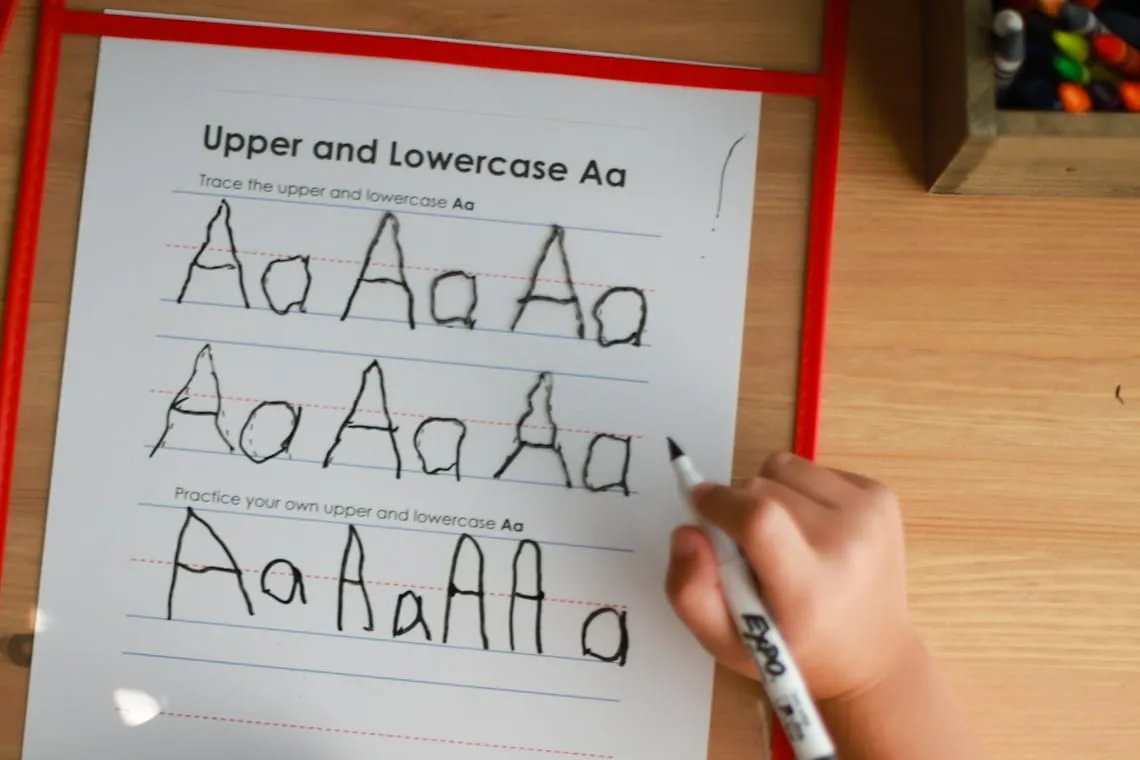
Leave alone. Uneven letters, drifting off the line, capitals appearing mid-word, and reversals — b for d is the classic, ordinary at this age, and not on its own a sign of dyslexia.
Do not ask for volume. The same English guidance warns that “expecting children to write at length early on results in cognitive overload and might damage their motivation to write, both at this stage and later.” Five focused minutes beats a page of grinding, and the grinding costs motivation that is hard to buy back.
Ages 7 to 8: consistency, and the size problem
What is happening. Letters are known; now they have to come out the same every time. This is where most parents first notice something is wrong, and the most common complaint is size.
Oversized writing is not carelessness. It is what a child produces when nothing on the page tells them how big a letter should be. Most practice material makes it worse by printing enormous models to trace — training the hand at a size the child will never actually use, which then has to be unlearned.
What helps is ruled lines with a marked midline, so tall, small and tailed letters each have somewhere to aim, and models set at the size the child is genuinely expected to write.
Check by family, not by letter. Handwriting problems run in groups, because a group is one hand movement rather than one letter. The eight groups below are the ones our practice sheets teach, in the order Zaner-Bloser uses:
- Straight down: l i t
- Curl back, all the way round: o a d
- Curl back and stop: c e f
- Round, then a tail under the line: g j q
- Down, then back up and round: u s b p
- Down, back up, over and down: r n m h
- Slant down, slant up: v y w
- Two slants, or across and slant: x k z
If one letter is going wrong, look at the rest of its family — the fault is almost always shared. It is also why teaching letters in alphabetical order makes the job harder than it needs to be: a and b have nothing in common except adjacency.
Ages 8 to 9: the cursive question
This is when joining usually comes up, often because school is not addressing it, and the honest answer is less settled than either camp claims.
The case for. Semeraro and colleagues randomized 141 Italian first-graders and found the cursive-taught group wrote faster — 16 versus 11 letters per minute — and made fewer spelling mistakes. (The reading comprehension results were mixed, better at some measurement points and not others.) Before quoting that at anyone: the comparison group was learning uppercase, lowercase, print and cursive simultaneously, so the result may show the benefit of teaching one script properly rather than the benefit of cursive. Italian spelling is also far more regular than English.
The case against. Yekeler Gökmen and colleagues timed 322 students in grades 4 to 8 copying text for one minute. Speed rose with grade, girls wrote faster than boys — and students writing print wrote faster than students writing cursive. That is the opposite of the usual claim made for cursive, in an older sample doing the very task cursive is supposed to be better at.
England’s reading guidance, meanwhile, advises schools to consider delaying joined handwriting, citing inspectors’ finding that nearly all the school leaders surveyed taught no cursive in the first school year because it slowed children down at an age when their fine motor control was still developing.
The useful answer is a readiness test, not an age. A child is ready to join when they can form all 26 lowercase letters correctly with a comfortable grip, keep size and spacing reasonably consistent, and have started joining letters unprompted. Every one of those is about print being finished. Cursive is not an escape from messy printing — it is what comes after printing stops being hard.
Optional for most children. Genuinely useful for some, particularly those who find handwriting effortful, where a continuous line means fewer stops and starts.
Ages 9 to 12: speed under pressure, and a hand of their own
What is happening. Explicit teaching is over. What remains is mileage, and the demand shifts from legibility to endurance — writing to record, in every subject, often against the clock.
Personalization is the goal, not a problem. Once the standard form is secure, children adapt it: their own slant, efficient shortcuts, neatness traded against speed depending on the task. A twelve-year-old whose handwriting no longer resembles the alphabet chart is doing this correctly.
What to watch is the gap between what they can say and what they can get down. That gap is what actually costs marks, and it is regularly mistaken for a writing problem when it is a transcription problem. A child who talks fluently about a topic and then produces four thin sentences is not short of ideas — remember the grading experiment above, and what it implies for a child like that in a timed test.
When to stop worrying, and when to ask
Most of what worries parents at five has resolved by eight with no intervention. Reversals go. Uneven size goes. Grip usually settles.
What is worth raising with a teacher, and possibly an occupational therapist, is different in kind:
- pain, fatigue, or a hand that has to be shaken out after a few lines
- active distress or avoidance around any writing task
- a grip unchanged after a year of reminders
- handwriting that is not improving at all while everything else is
- a persistent gap between what the child can say and what they can write down
Those need someone who can watch your child write. No article and no worksheet can answer them.
What the evidence says practice material should look like
Put the findings above in one place and they read as a specification:
- The child must produce the letters. Tracing did not engage the reading circuit; motor drills did not improve handwriting. Dotted models are scaffolding for a first attempt — the learning happens in the rows the child writes unaided. Material where tracing is the whole activity fails the evidence twice over.
- Models at real writing size, on guide lines. A hand trained on two-inch letters has practiced a movement it will have to unlearn. Guide lines with a marked midline give tall, small, and tailed letters each a target, at the size the child will actually write.
- Letters grouped by pencil stroke, not by alphabet. Letters that share a movement should be learned together, with a cue for where the pencil starts and which way it goes — because the movement, not the shape, is what the hand is learning.
- Short sheets, short sessions. Demanding volume early produces cognitive overload and damages the motivation to write. One focused sheet beats an afternoon of grinding.
- Letterforms that match what children read. Most handwriting programs still teach models designed generations ago, for a world where adults wrote all day. Children today read enormously more than they write, and nearly everything they read is set in modern type. Letters shaped like the ones in their books are reinforced by every page of reading — and stay readable for life.
We built our two handwriting practice packs to that specification, because we could not find material that met it. Every traced row is followed by rows written unaided. Every model sits on guide lines at true writing size. Letters come in groups that share a pencil stroke, each with a spoken cue for how it is formed. Every sheet is one short session. And the letterforms are taken from a modern typeface — upright, even, with the single-story a and g children actually read every day.
- Print handwriting practice sheets (PDF) — for a child learning to form letters: pencil-control movements, every letter and numeral in stroke groups, then sight words, sentences, and a real letter to write.
- Cursive handwriting practice sheets (PDF) — for a child who prints comfortably and is ready to join: every letter and every join, then words, paragraphs, a thank-you note, and a signature. It suits an adult relearning cursive as well.
Both are free to download and print at home. What is on each sheet, how many there are, and how they print.
What practice sheets cannot do
They cannot fix posture or grip. Those need somebody watching the child at the table — a sheet cannot tell whether the pencil is held in a fist.
They cannot tell you whether a difficulty is developmental or something needing assessment. A worksheet has no way of knowing your child, and any material implying otherwise is overselling.
And they cannot supply the reason to write. The most reliable practice a child ever gets is writing something they actually wanted to say to someone — a label, a list, a note left on a pillow. Sheets are efficient at the mechanical part, which is worth doing well precisely because it is what frees a child to stop thinking about letters at all. They are not the point of writing, and it is worth being clear with yourself about which one you are doing.
Sources (11)
- Common Core State Standards for English Language Arts, L.K.1.A and L.1.1.A.
- Feder, K. P., & Majnemer, A. (2007). Handwriting development, competency, and intervention. Developmental Medicine & Child Neurology, 49(4), 312–317.
- Skar, G. B., Lei, P.-W., Graham, S., Aasen, A. J., Johansen, M. B., & Kvistad, A. H. (2021). Handwriting fluency and the quality of primary grade students' writing. Reading and Writing.
- Graham, S., Harris, K. R., & Hebert, M. (2011). It is more than just the message: Presentation effects in scoring writing. Focus on Exceptional Children, 44(4), 1–12.
- Santangelo, T., & Graham, S. (2016). A comprehensive meta-analysis of handwriting instruction. Educational Psychology Review, 28, 225–265.
- Amundson, S. J. (1995). Evaluation Tool of Children's Handwriting. O.T. Kids.
- Graham, S., Berninger, V., Weintraub, N., & Schafer, W. (1998). Development of handwriting speed and legibility in grades 1–9. Journal of Educational Research, 92(1), 42–52.
- Yekeler Gökmen, A. D., Yıldız, M., Aktaş, N., & Ataş, M. (2022). Handwriting Speeds of 4th–8th Grade Students. International Electronic Journal of Elementary Education, 15(2), 123–136.
- James, K. H., & Engelhardt, L. (2012). The effects of handwriting experience on functional brain development in pre-literate children. Trends in Neuroscience and Education, 1(1), 32–42.
- Semeraro, C., Coppola, G., Cassibba, R., & Lucangeli, D. (2019). Teaching of cursive writing in the first year of primary school. PLOS ONE.
- Department for Education (England). The reading framework: teaching the foundations of literacy, handwriting section.