Pangolins
The only mammal covered in razor-sharp scales, these creatures can roll into an indestructible ball. Their sticky tongues are so long they are actually attached deep inside their chest.

Walking Pinecones
The pangolin looks like a walking pinecone, rolls up into an armored sphere, and hunts with a sticky tongue longer than its entire body. Found in parts of Africa and Asia, these creatures are the only mammals on Earth covered in hard, overlapping scales.
Razor-Edged Scale Shield
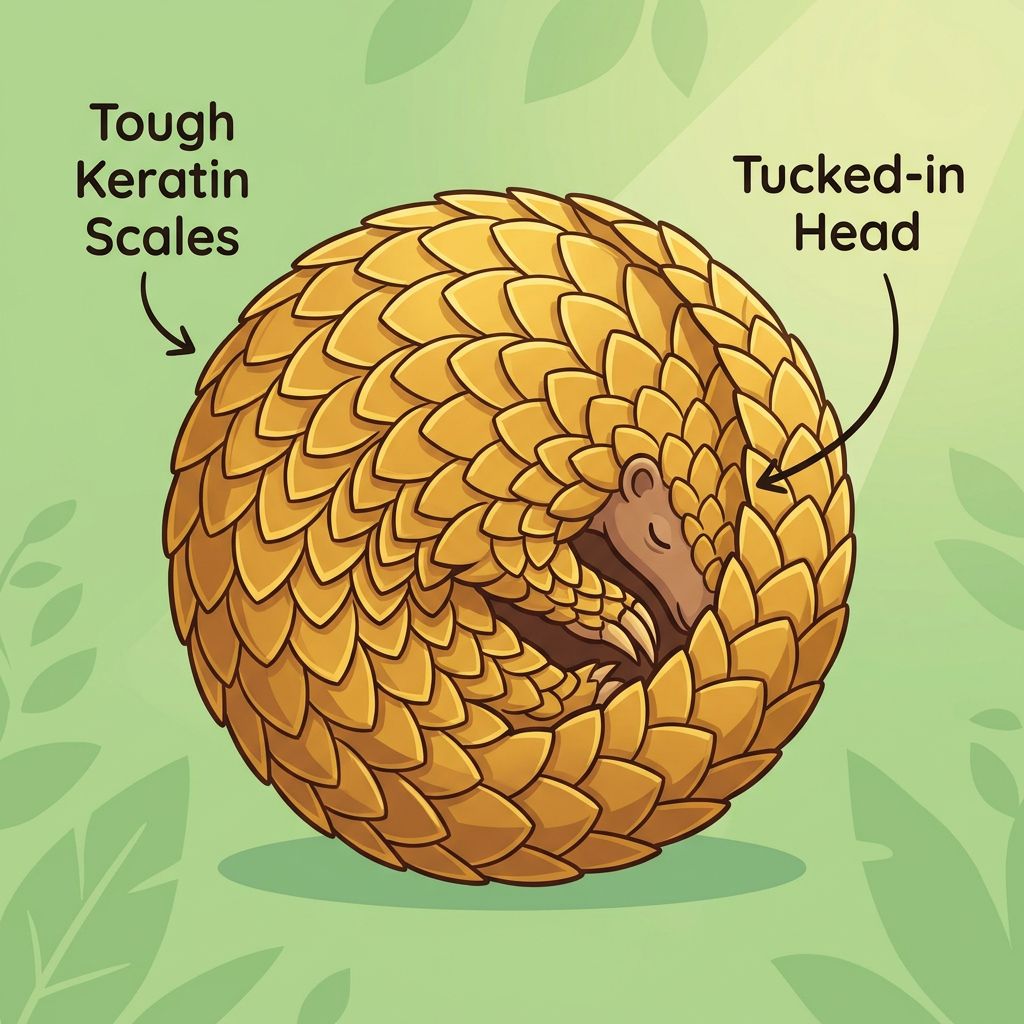
A pangolin’s scales are made of keratin—the same tough material found in rhino horns and eagle talons. These plates make up about one-fifth of the animal’s total weight. When a predator like a lion or leopard approaches, the pangolin does not run away. Instead, it tucks its head into its belly and rolls into a tight, solid ball. The scales have razor-sharp edges, creating a shield that even a big cat’s teeth cannot puncture. To make themselves even more unappealing, pangolins can spray a smelly fluid from glands near their tails, similar to a skunk.
The Ultimate Bug Vacuum
Pangolins do not have teeth. They do not need them. Instead, they use powerful, curved claws to tear open rock-hard termite mounds and rotting logs. Then, they launch their secret weapon: a sticky tongue. A giant pangolin’s tongue can be up to 16 inches (40 centimeters) long. It is so long that it is actually attached deep inside the chest cavity, near the pelvis, rather than the mouth. While the pangolin slurps up thousands of insects, it can seal its nostrils and ears shut so angry ants cannot crawl inside its nose or head.
Rocks in the Belly
Because pangolins cannot chew, their digestive system does the grinding. They swallow small stones and sand, which sit in a muscular part of their stomach. These stones act like internal teeth, mashing up the insects. When they travel, ground-dwelling pangolins walk on their hind legs, balancing on their tails while tucking their front claws inward to keep them sharp for the next dig.
Read Land Animals & Water Animals here or in the app
Read every story in both shelves right here on the web, or open them in Encyclopedia: Kids Learning with narration you control. The full 1,000+ topics come with the app, covering space, the human body, history and more. Ad-free, ages 5–12.