Flashcards have a bad reputation in adult conversation about kids’ learning, usually because the speaker is remembering being drilled on multiplication tables in the 1990s, not because the underlying technique was the problem. The technique is one of the better-evidenced things in cognitive science. The implementation in front of a 7-year-old is what either works or doesn’t.
This post separates the two and gets specific about what the research says for the 5–12 age range.
The spacing effect
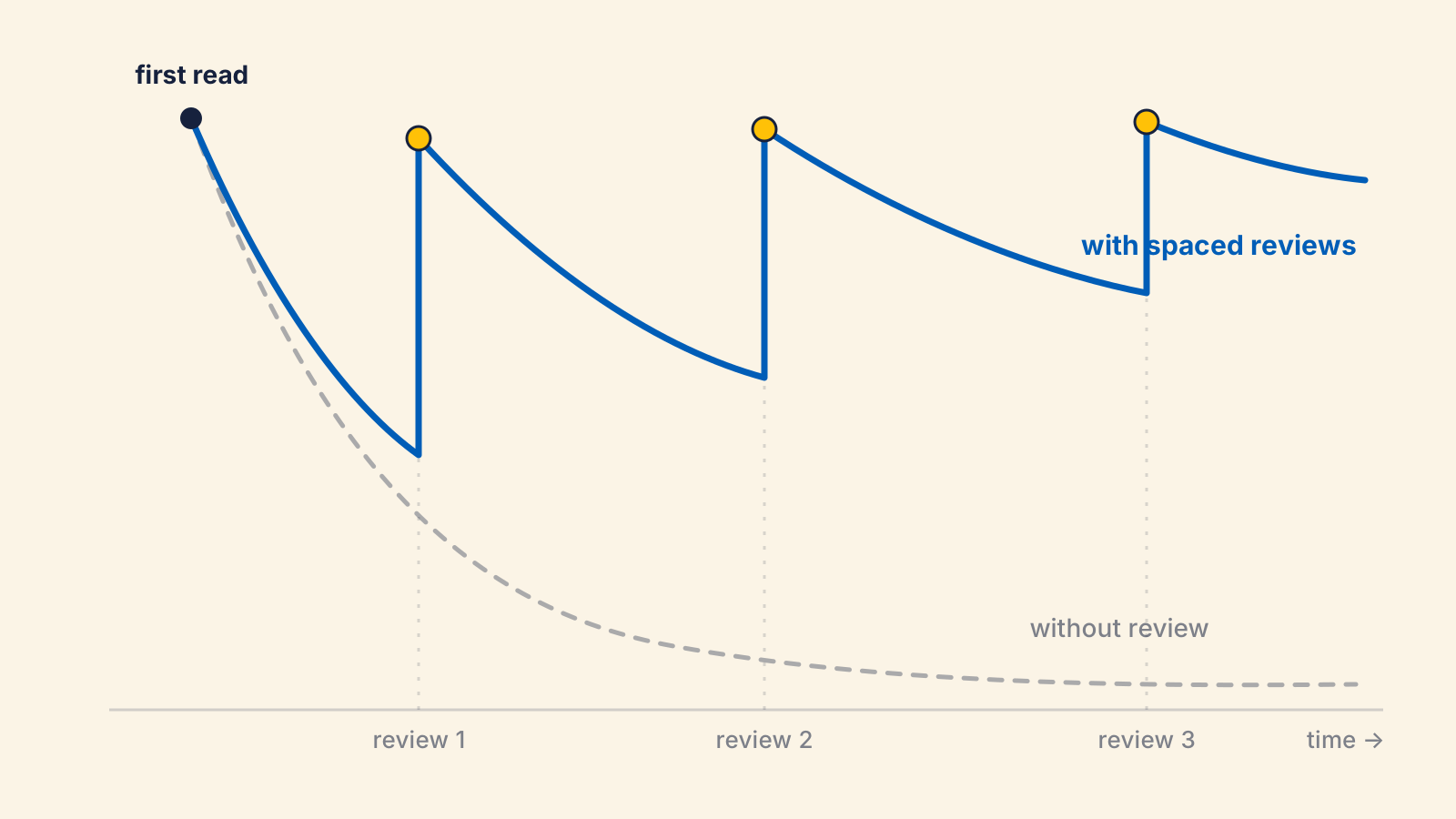
In 1885, Hermann Ebbinghaus did one of the first controlled psychology experiments, memorizing nonsense syllables and timing how fast he forgot them. The curve he produced has been replicated in countless forms since, and it tells you one durable thing: the optimal time to review an item is just before you would have forgotten it. Review too early and you waste effort. Review too late and you’ve forgotten, so you’re learning from scratch. Hit the window in between and the memory becomes durable faster than any other technique in the literature.
The 2006 Cepeda meta-analysis (Psychological Bulletin, 184 studies) put numbers on the effect: across the studies that reported them, distributed practice outperformed massed practice with effect sizes that hold across age groups. The same review found a useful operational rule: the optimal inter-study gap scales with the desired retention interval. Roughly: if you want to remember something for a week, review at 1–2 day intervals; if you want to remember it for a month, review at 1-week intervals.
The retrieval effect
Spacing is half the story. The other half — sometimes called the testing effect — was sharpened in a 2008 Science paper by Karpicke and Roediger. Students who tried to retrieve information from memory (a flashcard turn) outperformed students who restudied the same information for the same amount of time. The retrieval act itself, not the exposure, did the work.
This matters for any flashcard product. A card that asks the child to think and respond is doing something a card that just shows the answer can never do. Recognition is not retrieval. The product design that has the child surface the answer in their own head — even silently — before flipping is the one that takes advantage of the effect.
What’s different about kids 5–12
The Dunlosky 2013 review (Psychological Science in the Public Interest), a rigorous meta-analysis of dozens of learning techniques across age groups, ranked spaced practice among the top two most-effective techniques studied. It works for adults. It works for teens. It works for 5-year-olds. The technique itself doesn’t break down with age.
What changes with age is the binding constraint:
- Adults can sit through a 30-minute spaced-repetition session because their attention can hold for that long.
- Kids 5–12 cannot. A focused 30-minute session with a 7-year-old produces 5 minutes of useful work and 25 minutes of resentment.
So the design implication for the younger end of the range is straightforward: the session must end before attention does. That usually means 5 to 10 minutes for a 5- to 8-year-old, 10 to 15 minutes for a 9- to 12-year-old. Shorter and more frequent beats longer and rarer, every time.
The other thing that changes is metacognition. Adults can self-assess “I knew that” or “I didn’t know that” and adjust review intervals honestly. Kids, especially younger ones, are systematically optimistic: they’ll say they knew something when they actually pattern-matched the answer. A flashcard system that depends on the child to honestly self-rate their recall will overestimate retention for younger kids. The implementation has to account for that with conservative default intervals and lighter weight on self-rating.
What good kids’ flashcard design looks like
Translating the research into specific product properties:
- Short cards. One fact per card. A card with five facts is not five times better — it’s one card the child remembers nothing from.
- Short sessions. Hard-cap the session length and end on a strong note rather than dragging on until attention breaks.
- Conservative starting intervals. Default to tighter cadences for younger kids; lengthen as the system observes durable recall.
- Effort, not perfection. Reward showing up to a session, not getting every card right. The retrieval attempt itself is the learning event.
- Daily. A 4-day-a-week, 5-minute streak crushes a 1-day-a-week, 40-minute slog. The meta-analysis is unambiguous on this.
- No content gating. Flashcards are a study tool, not a paywall mechanism. Locking topics behind flashcard “completion” converts a study aid into a source of resentment.
How we apply this in Encyclopedia: Kids Learning
Disclosure: this is about our own app, with all the relevant skepticism that implies.
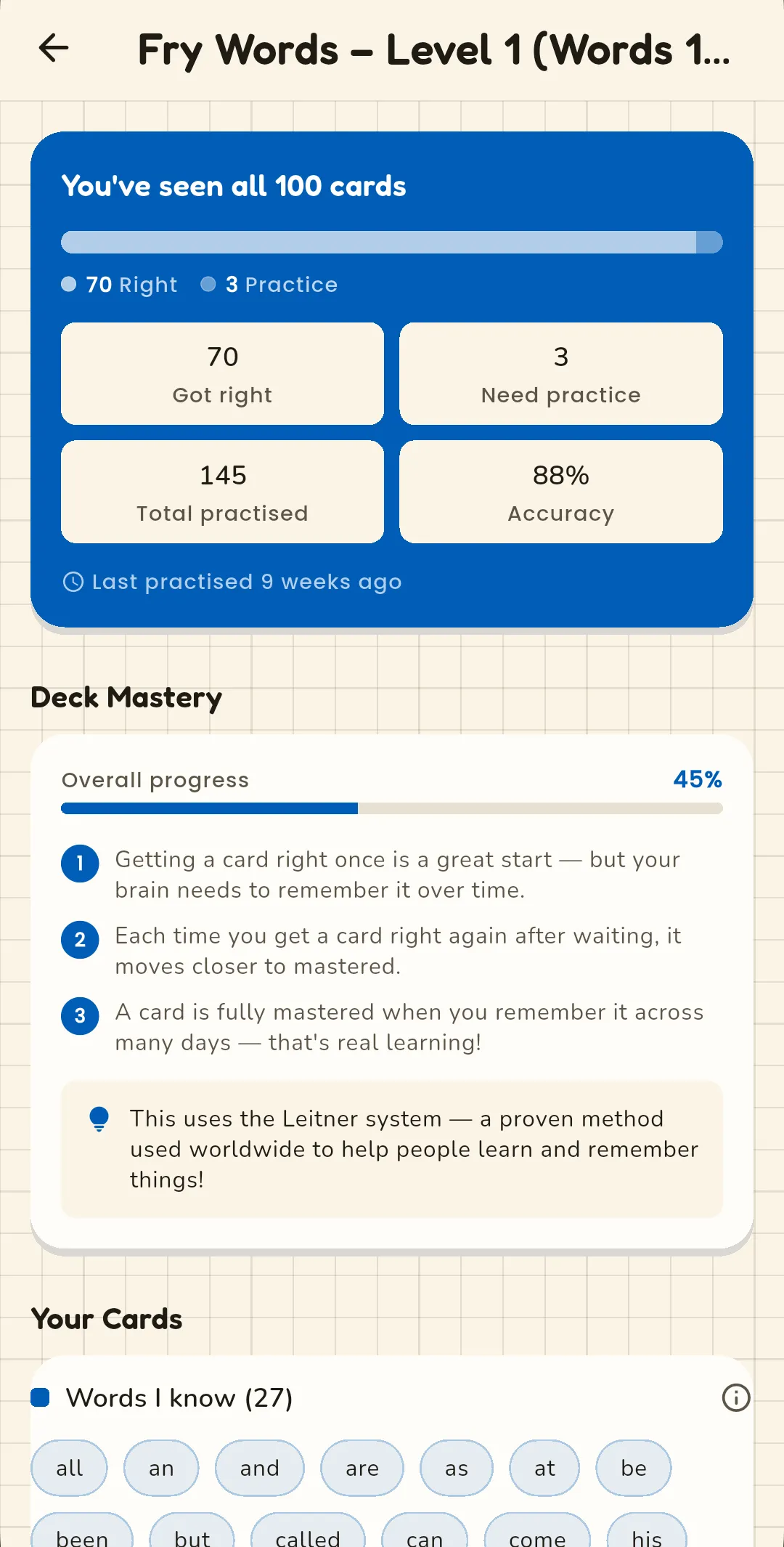
The flashcard decks in Encyclopedia are tuned for those constraints. Cards are single-fact, designed to fit on one screen without scrolling. A quick session is capped at 10 to 15 cards, a few minutes of work that ends deliberately rather than running until the child loses focus. The scheduler is a classic Leitner box system: each card moves up a box when recalled and drops back when missed, so review spacing lengthens exactly as durable recall is demonstrated, card by card. No topic content is gated behind flashcard progress; flashcards are a separate, optional review surface.
Nothing about this is novel. The science has been settled for decades. What is genuinely useful is packaging the technique in a way a 7-year-old will actually open tomorrow.
Honest limits of the technique
Spaced repetition is excellent at one specific thing: making facts you’ve already learned stick. It is not a replacement for the learning itself. A flashcard reviewing “Saturn has rings” doesn’t teach a child why Saturn has rings, what they’re made of, or how they got there. The reading does that.
The right use of flashcards in a kids’ learning app is as a reinforcement layer on top of the reading, for the few facts per topic that are worth keeping. The wrong use is as the primary learning mechanism. Apps that make their flashcard system the centerpiece are usually misunderstanding what the technique is actually for.
Sources
- Ebbinghaus, H. (1885). Über das Gedächtnis: Untersuchungen zur experimentellen Psychologie.
- Cepeda, N. J., Pashler, H., Vul, E., Wixted, J. T., & Rohrer, D. (2006). Distributed practice in verbal recall tasks: A review and quantitative synthesis. Psychological Bulletin, 132(3), 354–380.
- Karpicke, J. D., & Roediger, H. L. (2008). The critical importance of retrieval for learning. Science, 319(5865), 966–968.
- Dunlosky, J., Rawson, K. A., Marsh, E. J., Nathan, M. J., & Willingham, D. T. (2013). Improving students' learning with effective learning techniques. Psychological Science in the Public Interest, 14(1), 4–58.