Seahorses
Male seahorses are the ones who get pregnant and give birth to hundreds of tiny babies. These unusual fish are terrible swimmers but can vacuum up 3,000 shrimp a day.

The Worst Swimmers in the Sea
With the head of a horse, the eyes of a lizard, and the pouch of a kangaroo, the seahorse looks like a fantasy creature. Despite their strange shape, these creatures are actual fish. They just happen to be terrible at swimming.
Most fish use a large tail fin to zoom through the water. Seahorses do not have one. Instead, they steer using two tiny fins on their cheeks and propel themselves forward using a single fin on their back that flutters up to 35 times per second. To go up and down, they adjust the gas inside an internal balloon called a swim bladder. Because they struggle against even weak ocean currents, they spend most of their time anchored. They wrap their curly, square-ringed tails around coral or seaweed to avoid getting swept away by the tide.
Vacuum-Cleaner Snouts
Seahorses do not have teeth, and they do not have stomachs. Because food passes through their simple digestive systems almost instantly, they must eat constantly to stay alive. A single seahorse can devour up to 3,000 tiny brine shrimp in a single day.
Without teeth, they rely on high-speed suction. When a shrimp drifts near, the seahorse snaps its head forward. Its long snout acts like a vacuum nozzle, sucking the prey inside in less than six milliseconds. That is fast enough to escape the notice of most underwater predators—and faster than the speed of a snapping finger.
Super-Dads of the Reef
Seahorses flip the script on parenting. In this family, the father is the one who gets pregnant.
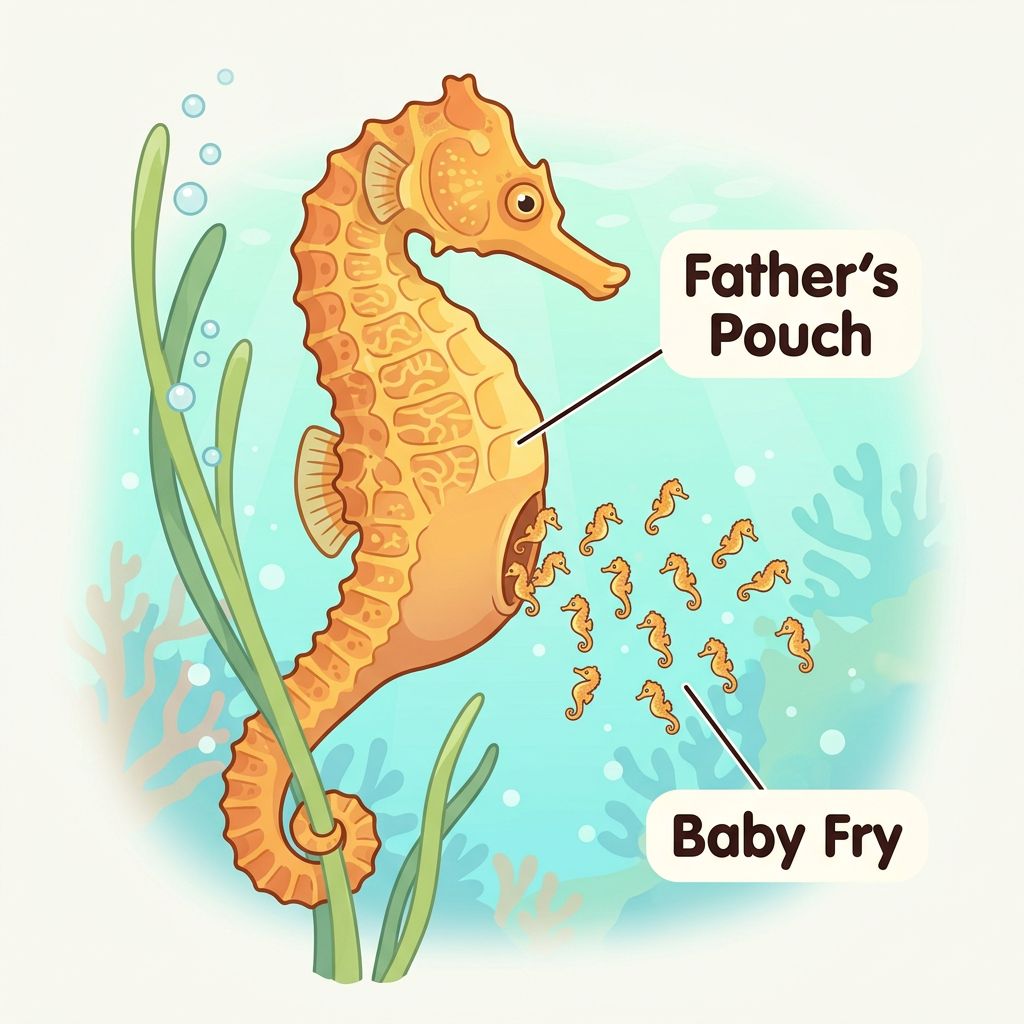
The female seahorse deposits her eggs into a special pouch on the male’s belly. Once inside, the dad fertilizes the eggs and keeps them safe for up to four weeks. His pouch acts like a womb, providing the growing babies with oxygen and nutrients. When they are ready, the dad’s body squeezes to shoot hundreds of tiny, fully formed baby seahorses (called fry) out into the water. Each baby is smaller than a single grain of rice, immediately drifting off to find its own piece of seaweed to hug.
Read Land Animals & Water Animals here or in the app
Read every story in both shelves right here on the web, or open them in Encyclopedia: Kids Learning with narration you control. The full 1,000+ topics come with the app, covering space, the human body, history and more. Ad-free, ages 5–12.